Friday, May 2, 2014

 Elder and Sister Kneib outstanding in a field of Rapita in April.
 Rapita is a plant that is grown, from what we are told, for processing into bio-fuel.
Doina Stepanenco and Sister Kneib in a field of Rapita.
 The fields of Moldova in April.
 The village of Ghindesti lies along the river Raut.
 A lady herding her gaggle of geese in the village of Ghindesti.
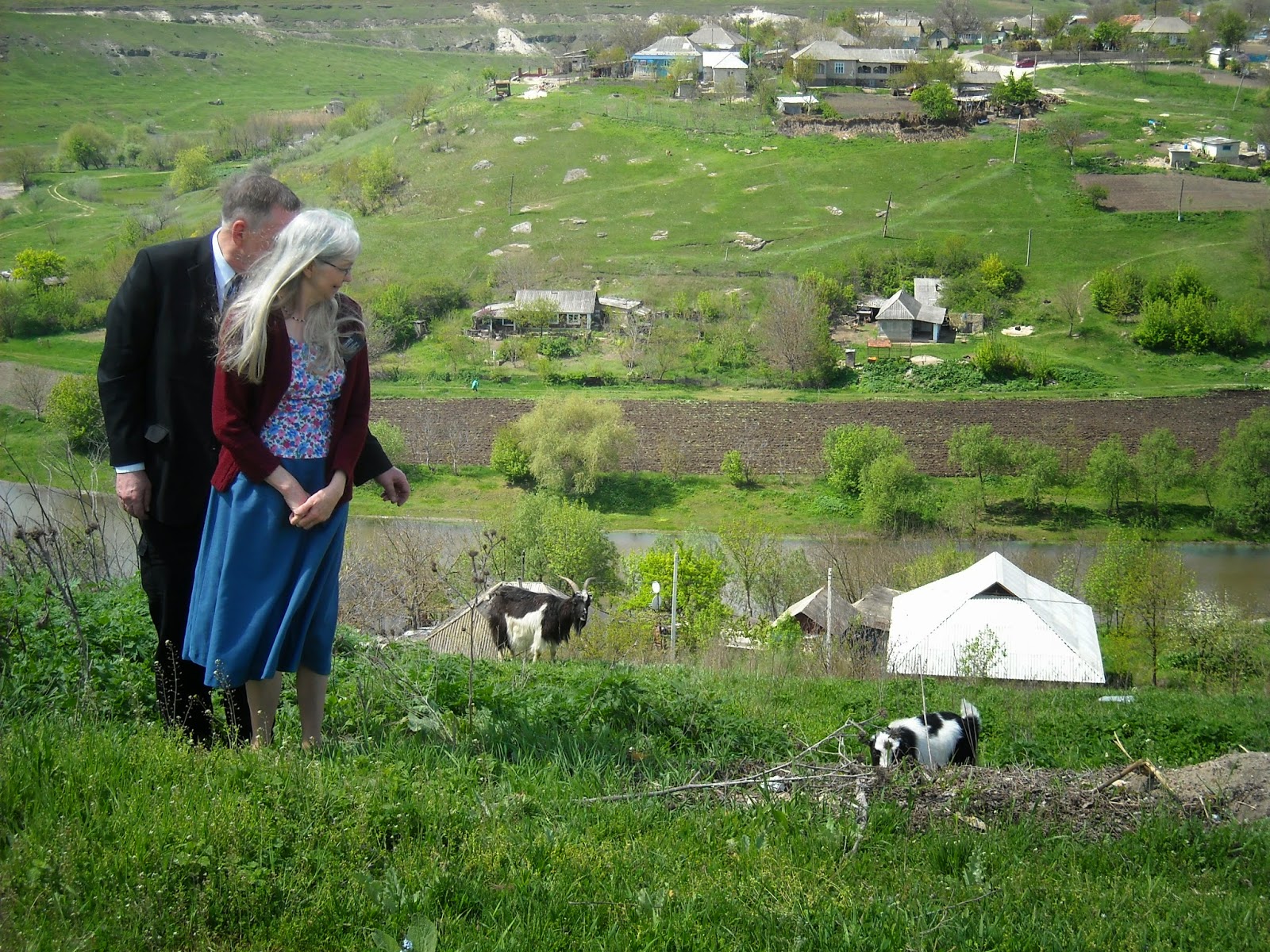
 Elder Kneib entertains a friendly and curious baby goat as the mother baa's in the background.
 Elder and Sister Kneib are surprised by the approaching baby goat who wants to find out what is going on.  The mother goat in the background shouts warning, but to no avail.
 Elder and Sister Kneib overlooking the River Raut in the valley near the village of Ghindesti.  Notice the caves in the side of the hill and the water fall.

Thursday, May 1, 2014

 On April 16, 2014, Arlana and I drove to the village of Selemet to talk to the mayor and the village contractor who was hired to drill a new deep water well, construct a new water tower, and lay several miles of new water pipe for an area of the village to have indoor running water.  Near the mayor's office, we saw this huge nest on top of a power pole with a stork preening itself.  A nesting stork is said to be a sign of good luck.  The Selemet mayor wants the church to help in financing a clean water project in the village.
 Near the Stork's nest was this gaggle of geese.
 We came to Selemet a day after a rainfall and everything was wet and muddy.  This is the village main street crossing the river bridge and heading to the part of the village that will benefit from the clean water project.  There were no side walks nor paved streets.
 A side street shows a lady walking past one of 192 shallow dipping water wells that are located thoughout the village.
 There were also a lot o chickens in the village.
 A closeup view of the shallow water well.
 A common practice was to harvest the corn stalks in the autumn and bring them to the village and stack them around the houses as wind breaks and to burn as fuel.
 Also in the village were turkeys....
 and ducks.....
 and sheep.....
 and cows.
 This is a picture of and old but useable tracked tractor with a cultivator.
 Also in the village were goats....
 and horses.  Horses are very popular to take people and carts around the village instead of cars or trucks.
 Notice the cart's suspension!
 This is a typical scene where there is no indoor plumbing.

Arlana is visiting with the Selemet mayor who was touring us around her village.  We were at the end of the road and we had to turn around.  The mayor was afraid that we would get stuck.  Luckily, we had 4-wheel drive and had no problem returning to the main street.

Wednesday, April 30, 2014

 On April 15, 2014, the village of Capalia engineer, assistant mayor and mayor Alexei Busuioc visited our apartment in Chisinau to sign the Capaclia Clean Water Project Agreement.  The church is donating over  $94K so that the village can have running water in their homes and schools.
 Also signing the agreement is Lidia Jubea, president of Spectru, the construction contractor who will construct the water tower, renovate the deep well, and lay new water pipe in the streets of the village.  Also in the picture is Doina Stepanenco, Elder Kneib's translater.  Lidia cannot speak English and Elder Kneib cannot speak Romanian nor Russian.  The mayor speaks some English, French, Romanian, and Russian.
 Three copies of the agreement were signed and stamped so that each party could have a signed copy.

When everything was signed and stamped, hands were shook, and smiles broke forth.  Capaclia is going to have running water for their indoor plumbing, hopefully, before summer ends for the first time in 19 years.

Friday, April 4, 2014

 In March 2014, Arlana and I were at the train station to see off some missionaries as they were being transferred to Romania.
 While we were touring the school at the village of Porumbrei, Moldova, a flock of Turkeys came towards us.  I was almost like they were "watch dogs"!
 But, I guess the turkeys were looking for a handout!
 At the National Museum of History of Moldova, Arlana looks at huge diorama of a seen that took place during WW II.
 A display at the National Museum of History of Moldova shows some military artillery.
 A section of the Museum of History is dedicated to the time when Russia was in control of the country.  As seen above, it appeared to be similar to the holocaust that took place in Germany.
 Some more information about the occupation of the country by the Russians is shown above.  The voters of this country need to see this exhibit before they vote!  Some people in this country still favor the Russian way of life!
 The Museum also has an outdoor display showing some rock carvings around burial locations.  These statues are dated to sometime BC and were found in the Moldova area.
Arlana is standing in front of the entrance to the National Museum of History of Moldova.  We visited the Museum on 29 March 2014.

Friday, February 7, 2014

 This is the scene outside of our apartment window after an 11-inch snow fall on January 29.  The temperature was near 0 degrees F.
  
Even though we did not have any trips planned for this day, Arlana had to go out and see what the snow was like.  I was very dry and powdery.
Arlana is ahead walking to the grocery store from our apartment. The distance is only 1-1/2 blocks.
 This is the road to Ohrencia from Chisinau on January 31.  Since this was an international highway, it got priority is getting to see a snowplow.
 These are the students at the village school in Ohrencia.  They don't ordinarily dress in the native costumes, but this was a special day and they were participating in a school activity.
 The accordion is a common accompaniment.  The boy played what looked like a recorder.
 The Church Humanitarian Services donated to the village school these four tables equipped with benches for their dining hall.
 These girls are performing a circle folk dance.
 These children are doing another type of folk dance and singing at the same time.
 These children are singing.
 This is one of the classrooms.  Mr Ion Virlan, the director of the school, is standing in the middle.
 This is another classroom with the teacher in the background.  The church also donated a chalkboard in each of the classrooms.  The former chalkboard consisted of rough blanks of wood painted black.
The children are showing their excitement about be able to use and write so easily on the new boards.